Introduction to CertHub
Current Challenges in Regulatory Compliance
Ensuring regulatory compliance is essential for medical device manufacturers, but it is often a time-consuming and complex process. Teams must maintain alignment between Quality Management System (QMS) processes and Technical Documentation (TechDoc) while ensuring accuracy, traceability, and compliance with standards such as MDR, IVDR, and FDA regulations. However, traditional methods create significant challenges:
1. Manual Documentation Issues: Errors and Redundancies
2. Failure to Implement Quality Processes: Root Causes of Errors
3. Inefficient Manual Workflows
4. Lack of Traceability & Version Control
5. Disjointed Quality & Engineering Data
6. Slow & Fragmented Approvals
What CertHub Offers
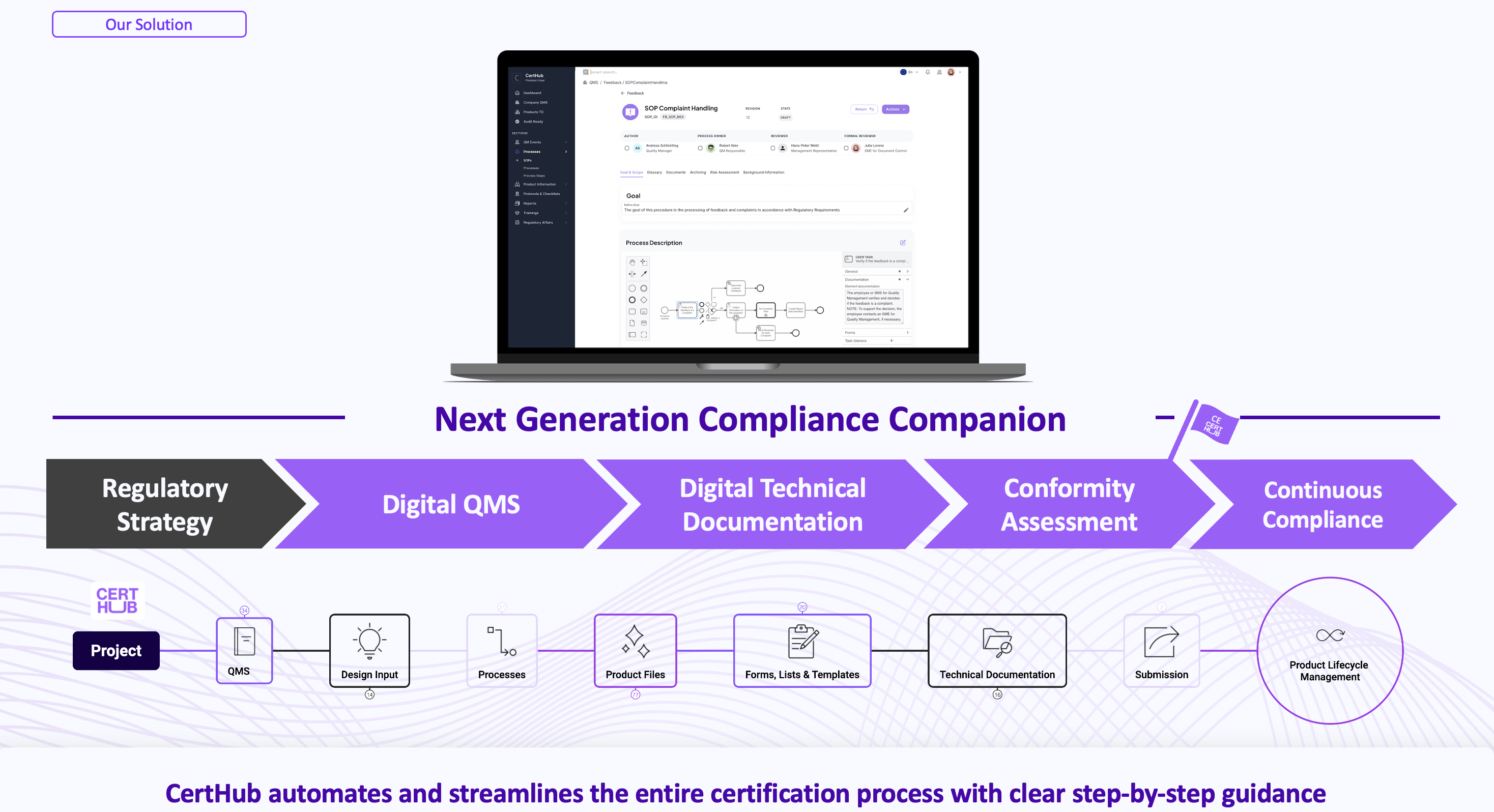
CertHub is a digital compliance platform
that automates regulatory documentation
by intelligently collecting and structuring compliance-relevant data.
Key Capabilities
With CertHub, you can:
- Define Processes, Data Inputs, and Automated Workflows
- Ensure Full Traceability & Versioning
- Bridge QMS and Technical Documentation
- Utilize Pre-Built Regulatory Templates for Guidance
By implementing CertHub, MedTech companies can:
- Reduce compliance complexity and administrative overhead
- Eliminate manual errors through automated data collection and structuring
- Achieve full traceability with real-time version control and audit trails
- Bridge the gap between quality management and engineering teams
- Accelerate approvals with efficient, integrated workflows
- Maintain regulatory consistency across all documentation and processes
Therefore, our Value Proposition:
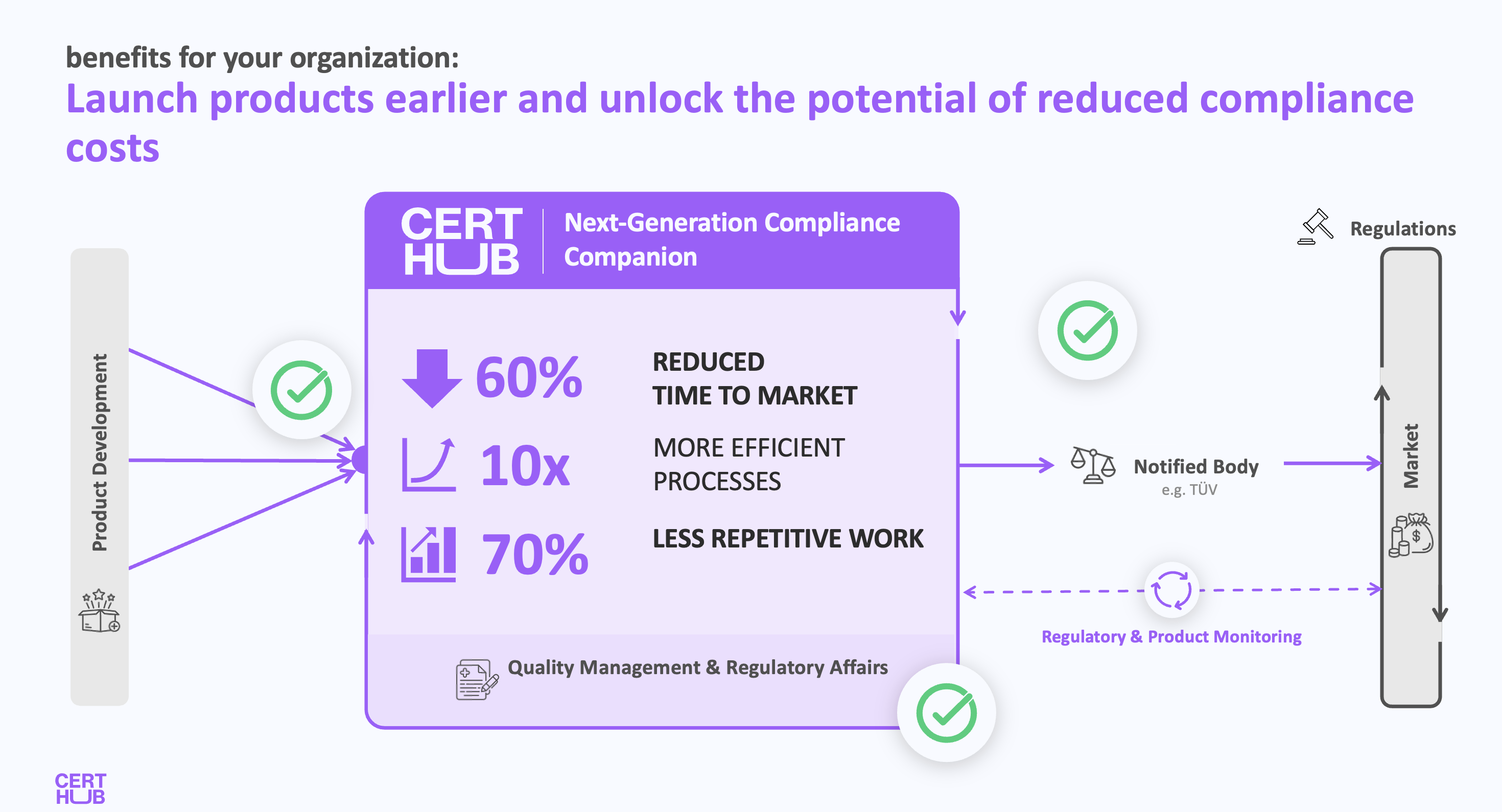
A Fully Customizable Compliance Solution
What is very important to acknowledge is that nothing in CertHub is hardcoded — our system is designed to adapt to your organization's unique needs.
Users can customize workflows, input formats, document structures, and compliance processes to align with their regulatory strategy while maintaining automation, consistency, and audit readiness.
The Road to Success
CertHub transforms your compliance journey from a complex, manual process into a streamlined, automated workflow. Starting from a string regulatoy strategy defined by your company, we digitise your QMS and TD information step by step until we rach certification!